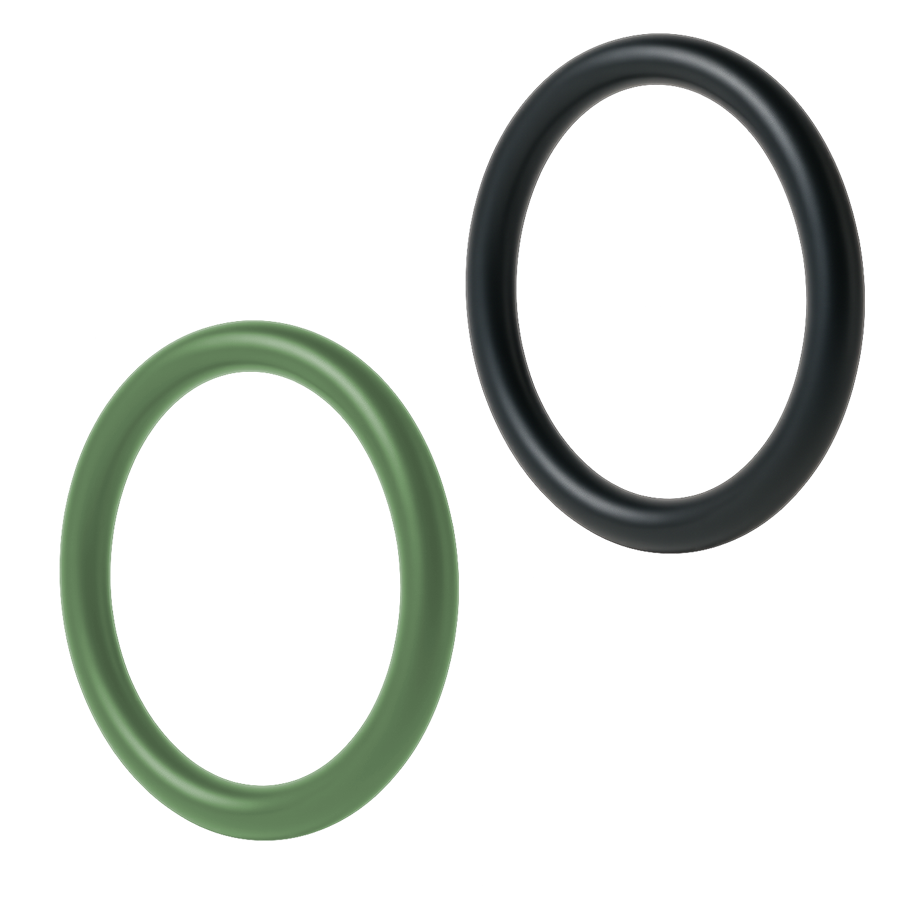

In the oil, gas, offshore, and subsea industries, O-rings may be small components, but they perform a critical role in maintaining the integrity of high-value equipment. These elastomer seals operate in some of the world's harshest environments, where they are exposed to extreme and fluctuating pressures, wide temperature ranges, aggressive hydrocarbons, chemical injection fluids, and sour gas containing hydrogen sulphide (H₂S).
Failure of a single O-ring can lead to loss of containment, unplanned downtime, environmental incidents, costly repairs, and serious safety risks. As a result, operators and equipment manufacturers rely on internationally recognised standards and material qualification programmes to ensure sealing reliability throughout the life of an asset.
Understanding offshore O-ring standards and certification requirements is essential for engineers, procurement professionals, maintenance teams, and project managers responsible for specifying sealing solutions in demanding oil and gas applications.
Why O-Ring Certification Matters in Offshore and Subsea Environments
Offshore and subsea equipment places significant demands on elastomer materials. Certified O-rings provide confidence that the seal material has been tested and qualified to perform under the conditions it will encounter in service.
Using qualified sealing materials helps ensure:
- Reliable sealing under high pressures and challenging temperatures
- Resistance to sour gas (H₂S), hydrocarbons, and aggressive chemicals
- Compliance with operator, project, and regulatory requirements
- Consistent manufacturing quality and material traceability
- Reduced maintenance costs and lower lifecycle risk
Ensuring you use certified O-rings is a risk management strategy, not just a regulatory requirement.
NORSOK Standards: M-710 & M-711 for Offshore Elastomers
Developed by the Norwegian petroleum industry, NORSOK standards were created to improve safety, reliability, and cost efficiency across the Norwegian Continental Shelf. Today, NORSOK standards are widely specified throughout global offshore and subsea projects and are often regarded as the benchmark for elastomer qualification.
While NORSOK compliance is not legally required outside Norway, many operators and equipment manufacturers specify NORSOK-qualified materials as part of their technical requirements. In practice, this can make compliance essential for participation in offshore projects worldwide.
It is important to understand that NORSOK standards qualify elastomer compounds rather than individual O-rings. To maintain compliance, manufacturers must produce seals using approved formulations, controlled manufacturing processes, and full batch traceability.
Key Points:
- NORSOK is not legally required outside Norway, but operators often treat it as mandatory.
- NORSOK standards focus on compound qualification, not individual O-rings.
- Approved elastomer compounds must be manufactured with controlled processes and full traceability to maintain compliance.
Scope of NORSOK Elastomer Standards
| Standard | Primary Focus | Relevance to O-Rings |
|---|---|---|
| M-710 | Qualification testing of non-metallic sealing materials | Defines thermal ageing, chemical resistance, and RGD testing |
| M-711 | Material requirements for elastomers | Sets property limits, mechanical performance, and manufacturing traceability |
NORSOK M-710 remains one of the most widely specified qualification standards for elastomer materials used in offshore and subsea sealing applications, particularly where long-term reliability is critical.
Global Use of Offshore Elastomer Standards
While NORSOK standards originated in Norway, offshore operators worldwide often specify a combination of NORSOK, NACE, API, and ISO requirements depending on project location and operating conditions.
| Region | Commonly Specified Standards | Why It Matters |
|---|---|---|
| Norway / North Sea | NORSOK M-710 / M-711, NACE | Often contractually mandatory for offshore projects |
| UK North Sea | NORSOK, NACE, ISO | Ensures equipment acceptance by multiple operators |
| Middle East | NACE, operator-specific | Focus on sour service and chemical resistance |
| Gulf of Mexico | NACE, API, ISO | Meets regulatory and operator requirements |
| Asia-Pacific Offshore | NORSOK (subsea), ISO, NACE | Demonstrates offshore reliability for subsea projects |
Understanding which standards apply to a project is a crucial part of selecting suitable offshore O-rings and sealing materials.
AED & RGD Testing for High-Pressure Elastomers
One of the most important considerations for offshore and subsea elastomers is resistance to rapid gas decompression (RGD), sometimes referred to as explosive decompression.
When an elastomer is exposed to high-pressure gas, molecules can permeate into the material. If pressure is released too quickly, the trapped gas expands faster than it can escape, causing internal cracking, blistering, or catastrophic seal damage.
| Term | Description |
|---|---|
| AED (Anti-Explosive Decompression) | Ability of elastomer to resist damage from rapid decompression under high pressure |
| RGD (Rapid Gas Decompression) | Physical phenomenon tested to evaluate elastomer resistance to explosive decompression |
AED/RGD resistance is particularly important in:
- High-pressure valves
- Subsea connectors
- Production manifolds
- Gas compressors
- Blowout preventers (BOPs)
- Downhole completion tools
Because pressure cycling is unavoidable in these applications, AED/RGD-qualified O-rings are often considered essential for long-term reliability.
NACE TM0187 for Sour Service
Hydrogen sulphide (H₂S) presents one of the most aggressive environments encountered in oil and gas production. Exposure to sour gas can accelerate elastomer degradation, resulting in swelling, embrittlement, cracking, and premature seal failure.
NACE TM0187, provides internationally recognised guidance for material selection in H₂S-containing environments. Compliance helps ensure sealing materials maintain their performance and integrity throughout service life.
Typical Applications Requiring NACE Compliance
While NORSOK focuses on overall offshore elastomer qualification, NACE specifically addresses material performance in sour service environments.
| Application Type | NACE MR0175 Requirement | Why This Matters |
|---|---|---|
| Sour Gas Production | Mandatory | Prevents H₂S-induced seal failure |
| Sour Oil Production | Mandatory | Ensures long-term integrity |
| Gas Processing | Mandatory | Maintains chemical compatibility |
| Sweet Service | Not Required | Standard elastomers acceptable |
O-Ring Material Selection and Certification
Selecting the correct O-ring material involves far more than choosing a polymer family. Performance depends on the complete compound formulation, including fillers, curing systems, and manufacturing controls.
As a result, generic material descriptions alone are insufficient when specifying O-rings for offshore, subsea, or sour service applications.
Elastomer Materials Availability.
For demanding offshore applications, HNBR, FKM, and FFKM compounds are among the most frequently specified materials due to their ability to satisfy multiple qualification requirements simultaneously.
| Material | NORSOK | AED / RGD | NACE | Typical Use | Notes |
|---|---|---|---|---|---|
| HNBR | ✓ | ✓ | ✓ | Oil & gas, sour service | Widely used in high-pressure sour applications |
FKM (Viton ) ) |
✓ | ✓ | ✓ | High-temp hydrocarbons | Select compound grades only |
| Aflas | ✓ | ✓ | ✓ | Sour gas wells, high-pressure gas systems, chemical injection systems | Excellent resistance to H₂S |
| FFKM | ✓ | ✓ | Extreme chemicals & temperature | Often used in critical subsea applications |
Only compounds that have passed recognised tests, should be used for these applications, contact Polymax to ensure you are selecting a certified compound.
Choosing the Right O-Rings
When specifying O-rings for offshore, subsea, and sour service environments, it is important to evaluate both the application conditions and the certification requirements.
Before selecting a sealing material, consider: 
- Required standards and project specifications, including NORSOK M-710, M-711, NACE TM0187, & TM0297.
- Operating pressures and temperature ranges
- Exposure to hydrocarbons, production chemicals, and sour gas
- AED/RGD resistance requirements
- Material certification and traceability documentation
- Long-term reliability and maintenance considerations
Selecting the correct offshore O-ring requires more than matching material types. Certification status, pressure profile, temperature range, chemical exposure, and sour service requirements all influence sealing performance and operational reliability.
Our technical team can help identify compliant NORSOK, AED/RGD-resistant, and NACE-compliant O-ring solutions for your application. Contact us on +44 (0) 1420 474 123 or email us for expert technical guidance.